
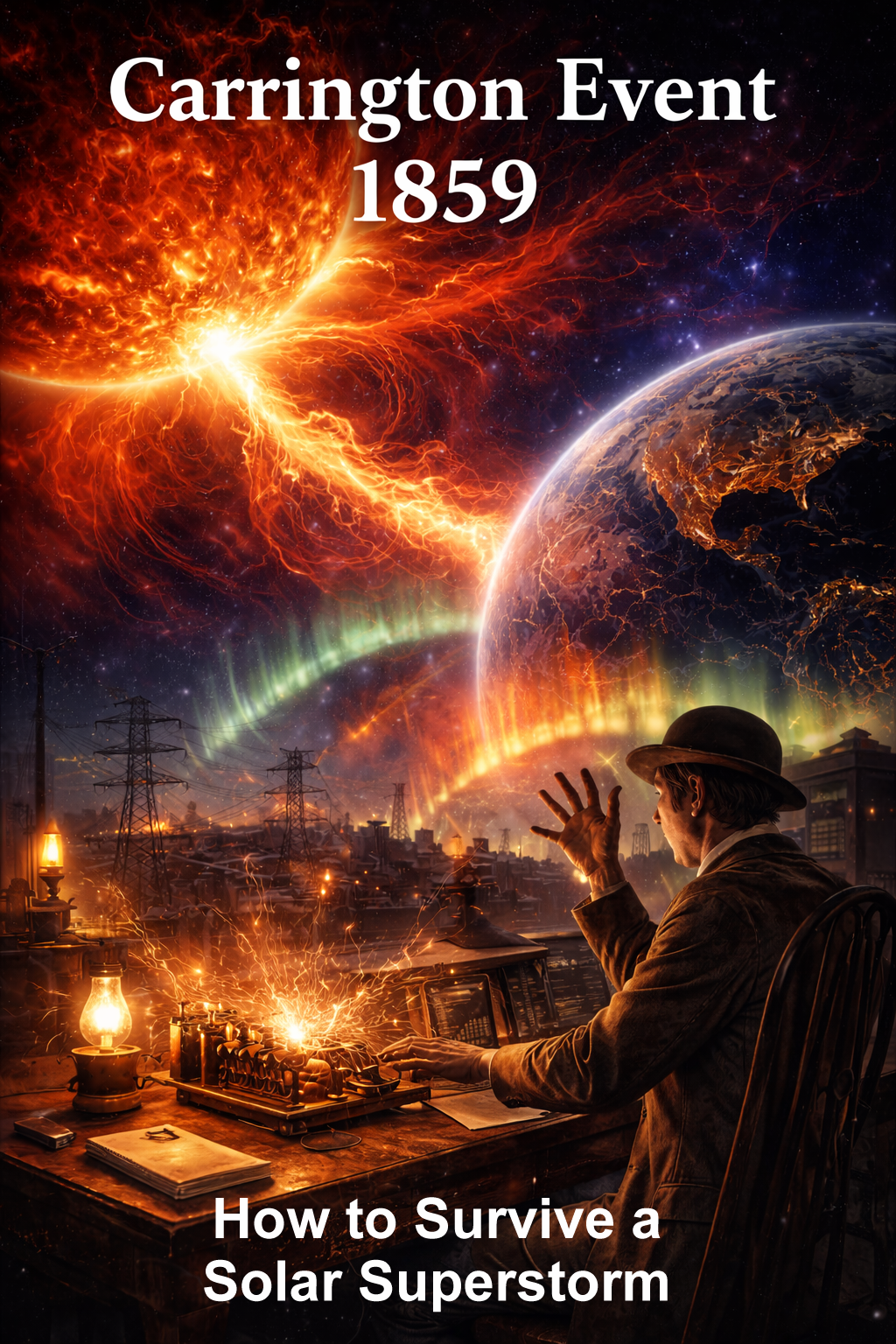
On September 1, 1859, British astronomer Richard Carrington witnessed something extraordinary: a massive white-light solar flare erupting from a cluster of sunspots. What followed seventeen hours later would become the most powerful geomagnetic storm ever recorded—an event so significant that 167 years later, it remains the benchmark for worst-case solar weather scenarios.
The Carrington Event 1859 set telegraph systems on fire, shocked operators unconscious, and created auroras so bright you could read a newspaper by their light at midnight—as far south as Cuba and Hawaii.
Today, the same event would trigger the collapse of modern civilization.
What Was the Carrington Event?
The Carrington Event was a perfect storm of solar fury. On September 1, 1859, Richard Carrington and Richard Hodgson independently observed a massive solar flare—an unprecedented observation at the time. The coronal mass ejection that followed traveled to Earth in just 17.6 hours, nearly twice as fast as typical CMEs.
When the 1859 solar storm slammed into Earth’s magnetosphere, it compressed the planet’s magnetic field so violently that the resulting geomagnetic storm was unlike anything witnessed before or since.
Telegraph systems across North America and Europe failed catastrophically. Operators reported sparks jumping from their equipment, paper catching fire, and electrical shocks strong enough to throw them across rooms. Some telegraph systems continued functioning even after being disconnected from their power sources—the induced currents from the geomagnetic storm were that powerful.
The Carrington solar storm created auroras visible from the equator to the poles. Reports describe people in the Rocky Mountains waking up at 1 AM thinking it was dawn because the sky was so bright. In Cuba, witnesses watched red and green curtains of light dance across the sky—an impossible sight under normal solar conditions.
When Was the Carrington Event (And Why It Matters Now)
When was the Carrington Event? September 1-2, 1859—but the real question is: why should we care about something that happened over 160 years ago?
Because it will happen again.
Solar physicists have identified multiple Carrington-class events in ice core and tree ring data, suggesting these extreme storms occur roughly once per century on average. The last confirmed Carrington-strength CME was in July 2012—and it missed Earth by pure luck, passing through our orbital position just nine days after we’d moved on.
We’re overdue for a direct hit. And unlike 1859, when the most advanced technology was the telegraph, we now depend on electronics for literally everything: food, water, medicine, communication, transportation, and heating or cooling.
The Carrington effect in 1859 was inconvenient. The Carrington effect today would be apocalyptic.
What If the Carrington Event Happened Today?
Engineering studies attempting to answer what if the Carrington event happened today paint a terrifying picture. Let’s walk through the timeline:
Hour 0 – CME Impact: The coronal mass ejection slams into Earth’s magnetosphere, compressing it violently and beginning to induce massive electrical currents in anything conductive.
Hours 1-4 – Grid Failure: Power transformers across entire continents begin overheating and failing as geomagnetically induced currents exceed design tolerances. Grid operators attempt emergency shutdowns, but it’s too late for many systems. The cascading failures spread as neighboring grids try to compensate and overload in turn.
Hours 6-12 – Communication Collapse: Cell towers lose power. Satellites in low Earth orbit suffer radiation damage and electronic failures. GPS signals become unreliable or disappear entirely. Internet backbone infrastructure begins failing as data centers exhaust backup power.
Day 1-3 – Supply Chain Breakdown: Gas stations can’t pump fuel. Banks can’t process transactions. Food distribution networks collapse as refrigeration fails and tracking systems go offline. Water treatment facilities exhaust backup generator fuel.
Week 1-2 – Medical Crisis: Hospitals run through backup power. Medications requiring refrigeration spoil. People dependent on electrical medical devices begin dying. Emergency services become overwhelmed.
Month 1-3 – Social Collapse: Food riots begin as supermarkets empty and don’t restock. Water becomes contaminated as treatment facilities fail. Disease spreads rapidly. Violence escalates as desperate people compete for limited resources.
Year 1 – Mass Mortality: Conservative estimates suggest 90% population mortality in heavily affected regions through starvation, disease, contaminated water, and violence. The survivors face a world without functioning infrastructure, depleted resources, and a years-long recovery timeline.
This isn’t science fiction. This is what the engineering analysis tells us would happen during a modern Carrington Event.
When Is the Next Carrington Event?
The question when is the next Carrington event haunts space weather scientists and disaster preparedness experts. The uncomfortable answer is: we don’t know, but the risk is highest during solar maximum.
We’re currently in solar cycle 25’s maximum phase, which extends through 2026-2027. This is the window when the sun’s magnetic field is most active, most unstable, and most likely to produce extreme events.
CME survival checklist solar storm preparations should be happening now, not after we detect an Earth-directed CME. Remember, even fast-moving CMEs give us only 12-18 hours of warning—barely enough time to act if you don’t already have a plan.
Historical solar maxima cycles show clustering of extreme events during peak periods. The pattern is clear. The threat is real. The question is whether civilization will get lucky again or whether our number is up.
The 1859 Solar Storm: Lessons in Fragility
One of the most sobering aspects of studying the 1859 solar storm is recognizing how fragile our technological civilization has become.
In 1859, society ran on muscle power—human and animal. Food was grown locally. Water came from wells and streams. Heat came from wood and coal. Transportation required no electronics. The loss of telegraph systems was inconvenient but not fatal.
Today? We’ve created a house of cards built entirely on reliable electrical power.
Your food comes from a supply chain spanning thousands of miles, all requiring electrical refrigeration and computer-managed logistics. Your water is pumped and treated using electrical systems. Your heat or air conditioning requires electricity. Your vehicle is managed by multiple computers. Your money exists as electronic data. Your medical devices require constant power.
Remove electricity, and everything fails simultaneously.
This isn’t a criticism of modern technology—it’s a recognition of systemic vulnerability. We’ve engineered incredible efficiency at the cost of resilience. And a Carrington solar storm would expose that trade-off in the most brutal way imaginable.
Emergency Procedure Guide: Why You Need a Plan
An emergency procedure guide for a Carrington-level event isn’t optional—it’s survival infrastructure.
When (not if) the next major solar storm occurs, you’ll have hours to act. What you do in those hours will determine whether you survive the following months or years.
You need to know:
- Immediate actions: What to do the moment you receive a solar storm warning
- Electronics protection: How to shield critical devices in homemade Faraday cages
- Resource acquisition: Final supplies to secure before impact
- Vehicle protocols: How to protect and recover your transportation
- Water security: Emergency storage and purification methods
- Food preservation: Keeping food safe without refrigeration
- Communication backup: Staying in contact without cell networks or internet
This information needs to be accessible when the power is out—which means printed, organized, and stored where you can find it in the dark.
The CME Survival Checklist You Actually Need
The CME survival checklist solar storm guide I created isn’t a generic emergency kit list. It’s a comprehensive 46-page manual specifically designed for Carrington-level events, organized by timeline and action priority.
The How to Survive an 1859 Carrington Solar Storm Strength CME/EMP: Printable Checklist & Emergency Procedure Guide includes:
- Immediate Response Checklists: Organized by hours before impact—what to do at 12 hours out, 6 hours out, 60 minutes out
- During-Storm Protocols: How to protect yourself and your equipment during the actual geomagnetic storm
- Post-Storm Recovery: First 24 hours, first 72 hours, first week action plans
- Vehicle Recovery Procedures: Diagnosing and repairing electronics damage
- Long-Term Survival Planning: Food, water, security, medical, and communication strategies for extended grid-down scenarios
- Faraday Cage Construction: DIY electromagnetic shielding with common materials
- Reference Poster: Quick-action guide in printable 8.5×11″ format
- Bonus: 30 Coloring Pages: Family morale tools for extended crisis periods
For CA$7.99—less than a single emergency meal—you get professionally organized survival information that addresses the specific challenges of a Carrington Event in the modern world.
History Doesn’t Repeat, But It Rhymes
The Carrington Event happened once. It will happen again. The only questions are when, and whether you’ll be ready.
We can’t stop the sun. We can’t prevent coronal mass ejections. We can’t force governments to harden infrastructure against space weather threats.
But we can prepare ourselves. We can protect our families. We can have a plan.
Get your printable survival guide here and start preparing today—because the next Carrington solar storm won’t wait for you to feel ready.