
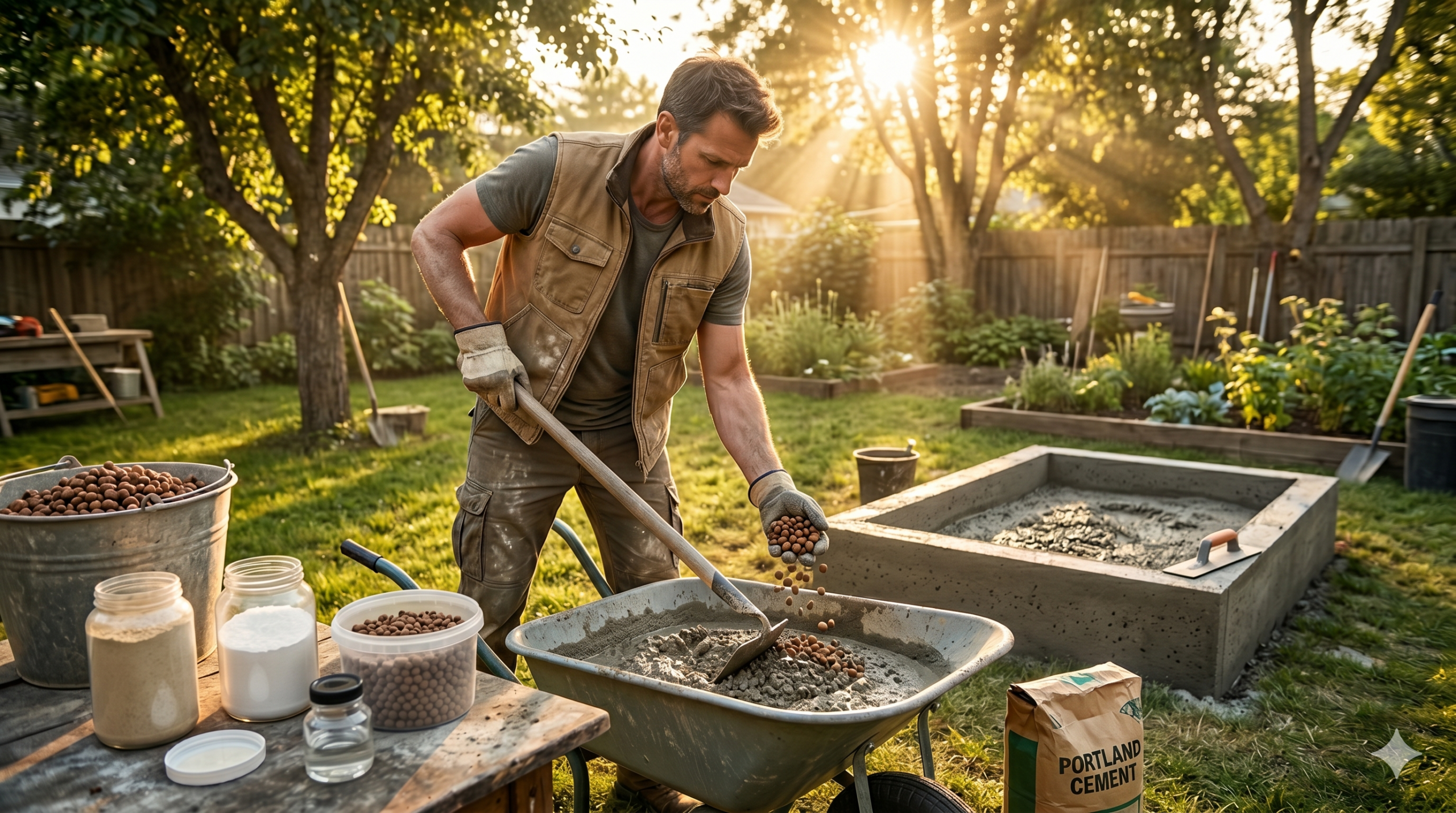
Simpler Than It Sounds – Microbial Biocementation & Mineral Carbonation
There are two special ingredients (bacillus bacteria and calcium lactate) that can be added to concrete in order to make it self-healing.
What does that mean?
It means that when concrete develops a crack—and it will always develop cracks—then water seeps into the crack and it will grow a form of limestone/crystals that seals the cracks—with the caveat that it can do so as long as it is not a serious structural issue.
In effect, the bacillus bacteria, which lie dormant until released to “grow” the substance that fills the void, then “heals” the cracks and solidifies the concrete without you needing to repair it later.
I asked three questions below to refine the answers about:
1) special self-healing concrete ingredients
2) DIY recipe
3) DIY applications
I hope you find this of some use for your own backyard / construction projects.
Bacteria – Genus: Bacillus
Bacillus is a genus of Gram-positive, rod-shaped bacteria characterized by their ability to produce endospores, allowing them to remain dormant in extreme conditions.
- Natural Habitats:
- Soil: Primary reservoir; ubiquitous in terrestrial environments.
- Water: Found in freshwater and marine sediments.
- Air: Disseminated via dust particles and aerosols.
- Biota: Common in the rhizosphere (root zones) of plants and the gastrointestinal tracts of insects and mammals.
- Key Traits: Aerobic or facultatively anaerobic; highly resistant to heat, desiccation, and pH extremes.
Calcium Lactate
Calcium lactate (C6H10CaO6) is the calcium salt resulting from the reaction of lactic acid with calcium carbonate or calcium hydroxide.
- Natural Occurrence:
- Fermentation: Produced naturally during the anaerobic metabolism of lactic acid bacteria (Lactobacilli) on sugars.
- Dairy: Found in aged cheeses (e.g., Cheddar, Parmesan) as white crystals formed when lactic acid reacts with calcium during the ripening process.
- Biological Systems: Present in trace amounts in the human body as a byproduct of glycolysis.
Interaction in Self-Healing Concrete (MICP)
The process you described is known as Microbially Induced Calcium Carbonate Precipitation (MICP).

The Biochemical Pathway:
- Activation: Water enters a crack, germinating the dormant Bacillus spores.
- Metabolism: The bacteria consume the calcium lactate (C6H10CaO6) and oxygen (O2).
- Precipitation: This metabolic activity converts the precursor into calcium carbonate (CaCO3), also known as limestone.
- Sealing: The limestone crystals grow and bridge the crack, restoring structural integrity and preventing further ingress of corrosive agents.
Technical Feasibility & Peer Review Audit
- Peer Reviewer Audit: The logic holds; the specific use of Bacillus pseudofirmus or Bacillus cohnii is required because they are alkaliphilic (can survive the high pH of concrete, which is typically ≈12−13).
- Feasibility Expert Audit: A primary engineering hurdle is the “shelf-life” of the bacteria within the concrete. Over time, the compressive strength of the concrete can crush the spores unless they are encapsulated in expanded clay pellets or vacuum-loaded into porous aggregates before mixing.
DIY Formulation & Materials
Creating a functional self-healing concrete at home is technically feasible using specific, accessible precursors. The primary challenge is protecting the bacteria from the high alkalinity (pH 12+) of the cement.
Core Ingredients Table:

Process Workflow
The “Pre-Loading” method is the most effective DIY approach to ensure bacterial survival.
Workflow:
    A[Prepare Saturated Solution] --> B[Dissolve Calcium Lactate + Bacillus in Water]
    B --> C[Soak Expanded Clay/Perlite in Solution]
    C --> D[Vacuum or Air Dry Pellets]
    D --> E[Mix Loaded Pellets into Concrete Mix]
    E --> F[Cast Concrete & Cure]
    F --> G{Crack Forms?}
    G -- Yes --> H[Water Ingress Activates Bacteria]
    H --> I[Limestone Precipitation Fills Crack]
Step-by-Step DIY Protocol
- Solution Preparation: Mix 5g of Calcium Lactate and 1g of Bacillus subtilis powder into 100ml of distilled water.
- Immobilization: Submerge porous aggregates (like Perlite or crushed expanded clay) in the solution for 24 hours. This allows the bacteria and nutrients to seep into the pores.
- Drying: Remove the aggregates and let them air-dry until the surface is no longer wet but the internal pores remain “loaded.”
- Mixing: Replace approximately 5-10% of your standard concrete aggregate with these “loaded” pellets. Mix with water and cement as per usual instructions.
- Activation: If the concrete cracks, keep the area moist. The bacteria require water to exit dormancy and begin the carbonation process.
Technical Feasibility & Peer Review Audit
- Peer Reviewer Audit: Using Bacillus subtilis is logically sound as it is a common, non-pathogenic soil bacterium that naturally forms spores. However, the DIYer must ensure the cement is not overly “hot” (high heat of hydration), which can decrease initial spore viability.
- Feasibility Expert Audit: The main hurdle is Mechanical Protection. Simply mixing loose powder into cement results in a >90% mortality rate for the bacteria. The use of a porous carrier (Perlite/Clay) is mandatory for any degree of success. Note that adding too much Calcium Lactate (over 5% by weight of cement) can significantly reduce the final compressive strength of the concrete.
Strategic DIY Applications
While industrial use focuses on bridges and tunnels, the “Meadow Standard” identifies four primary DIY domains where this technology provides the highest return on labor and material investment.

Performance Parameters
- Healing Capacity: DIY microbial concrete is most effective for cracks between 0.1mm and 0.8mm (roughly the thickness of a fingernail to a credit card).
- Activation Speed: Visual “healing” (white limestone precipitation) typically begins within 20 to 60 days of continuous or intermittent water exposure.
- Structural Note: This is a sealing technology, not a structural bonding agent. It restores water-tightness and prevents rebar corrosion, but it does not “glue” a snapped slab back together with the original tensile strength.
3.0 Mermaid Workflow: Maintenance-Free Cycle
Process:
    A[Cast Project with Bacillus/Lactate] --> B[Standard Use]
    B --> C{Micro-crack occurs?}
    C -- Yes --> D[Rain/Moisture Enters]
    D --> E[Bacteria Activate & Feed]
    E --> F[Limestone Fills Crack]
    F --> G[Waterfront Restored]
    G --> B
Technical Feasibility & Peer Review Audit
- Peer Reviewer Audit: The application to water-retention structures (ponds/cisterns) is the most logically sound DIY use. In these environments, the “trigger” (water) is constantly present, ensuring the quickest metabolic response from the Bacillus.
- Feasibility Expert Audit: For DIY patio or shed slabs, ensure the concrete is finished with a slight slope. While the bacteria heal cracks, standing water on the surface can lead to “scaling” if the calcium carbonate precipitates outside the crack rather than within it. For planters, the “Self-Healing” property significantly extends the life of thin-walled vessels which are traditionally prone to cracking from root expansion.
The original ‘video short’ that I watched, which inspired this post, is here on YouTube:
Let us know below how your project turns out if you try or have tried this method!
Research compiled by Meadow Cern
scribeworkss.com
Sources:
- Jonkers, H. M., et al. (2010). “Bio-based self-healing concrete.” Construction and Building Materials.
- Wang, J. Y., et al. (2014). “Self-healing concrete by use of microencapsulated bacterial spores.” Cement and Concrete Research.
- Khaliq, W., & Ehsan, M. B. (2016). “Crack healing in concrete using various bio-influenced self-healing techniques.” Construction and Building Materials.
- Jonkers, H. M. (2011). “Bacteria-based self-healing concrete.” Sustain. Build. Mater. Technol.
- Jonkers, H. M. (2025/2026 update). “Bacterial Concrete: Sustainable Infrastructure for Residential Use.” Techture Global.
- IJOER Engineering (2026). “Self-Healing Smart Concrete: Future of Sustainable Construction.”