
Beyond Memory Foam: How to Make or Build the “Biomorphic Matrix” Pillow
I have tried so many pillows without luck because I have cervical/neck pain from multiple past whiplash (and concussion) accidents. Arthritis in the bones just comes with age. I finally settled on a foam bead type pillow, but it’s “crunchy” sounding and moves a lot—too easily really. It doesn’t really keep the shape I put it in, and the fabric stretches too far, allowing the beads to move out and away from my head and neck through the night, causing loss of support.
What to do? Invent my own MUCH healthier pillow!
My goal was to use AI to research all the best materials for inside and outside the pillow so it would be eco-friendly using recycled or waste materials that are sustainable and natural, would not have any gassing off issues (VOCs) or chemicals, is hypoallergenic, nothing artificial, and would be made with quality design and last many years.
Usually I show the research through a Q&A format, but for this DIY pillow, I had Gemini summarize the information instead, show the benefits and features, as well as provide instructions/workflow to show my readers (you!) how to make this pillow yourself. All of the details (recipe and instructions) are included below. The research though is 100% from me–you won’t find this particular pillow anywhere else as I designed it based on the research results.
Introduction
The traditional pillow is a design failure. Polyester fill loses loft within months, memory foam “pushes back” with a chemical smell, and feather pillows migrate to the corners of the case, leaving your neck unsupported by midnight. Traditional foam beads are squishy but chemically offensive; straight up buckwheat pillows are supportive but can feel like sleeping on a bag of croutons.
Enter the Biomorphic Matrix. This is not just a pillow; it is a granular support system that utilizes friction-locking physics to create a custom-molded cradle for your head. Using 100% natural, hypoallergenic materials diverted from industrial waste streams, this build offers a fluid-yet-solid support that holds its shape until you decide to move it.
The Benefits of the Biomorphic Matrix
- Static Contour Support: Unlike foam, which constantly tries to return to its original shape, the Biomorphic Matrix holds the exact mold of your neck and head.
- Zero-Hardware Design: By using an invisible hand-sewn seal, there are no zippers or buttons to cause sensory irritation.
- Naturally Antimicrobial: High silica and suberin content in the grain and cork make this environment inhospitable to dust mites and mold.
- Breathable Climate Control: The hollow-tube structure of the Kapok and the air gaps between granules prevent heat buildup, ensuring a cool sleep surface.
Pillow Details
Dimensional Breakdown: 20” in width x 26”in length.
Standard Sizing: This specific measurement is the industry standard for a “Standard” size pillow. It is used to calculate the precise volume of ingredients needed—specifically 5.0 lbs of cork, 2.0 lbs of millet hulls, and 0.5 lbs of kapok—to ensure the pillow is approximately 75% full. This allows the materials enough headspace to shift and lock into place.
The “Double-Envelope” (Best for Adjustability)
This is essentially two bags with no hardware.
- Inner Bag: An “Envelope Closure” style bag made of a tight-weave cotton. It has a long internal flap (at least 6 inches) that tucks inside.
- Outer Case: A second envelope case, placed so the opening is on the opposite end of the inner bag.
- Result: The granules are trapped by the double-layered fabric flaps. There are no zippers or buttons to feel, and you can still open it to adjust the filling by simply reaching inside the flaps.
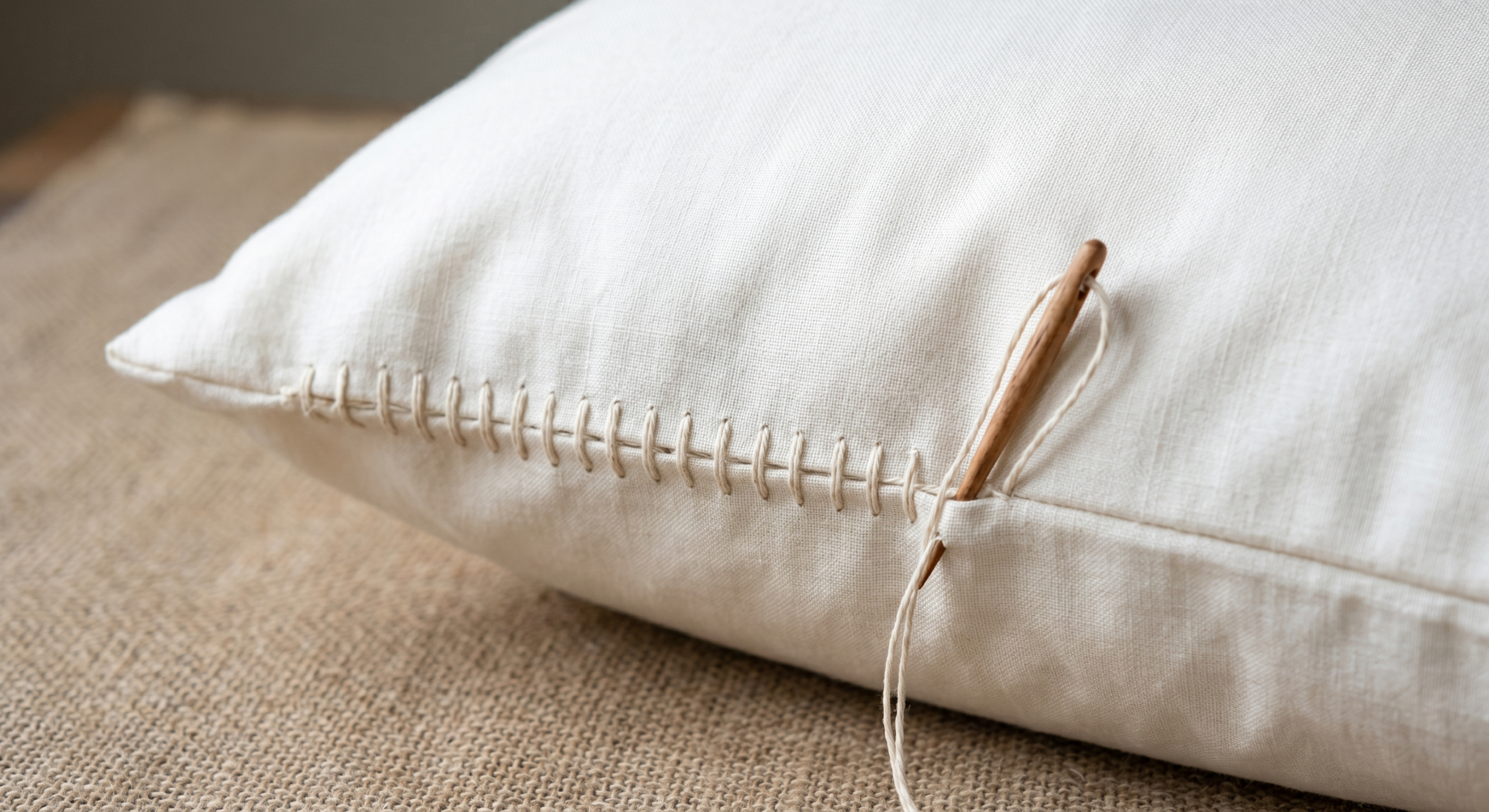
The “Ladder Stitch” (Best for Permanent Comfort)
If you find the perfect filling ratio and no longer need to adjust it, hand-sewing it shut is the gold standard for sensory issues.
- Technique: Use a Ladder Stitch (also called an invisible stitch) with heavy-duty organic cotton thread.
- Result: The seam becomes completely flat and identical to the other three sides of the pillow. It is effectively a “solid” fabric object with zero hardware.
The closure creates a permanent sensory-neutral seal.
Logic: This creates a seam that is functionally identical to the machine-sewn edges. There is no zipper “handle,” no “teeth,” and no cold metal or plastic. No buttons, no scratchy velcro. No chance of the pillow accidentally coming open, spilling its contents.
Neurodivergent Benefit: It eliminates the “tactile landmark” of a zipper, allowing the pillow to be rotated in any direction without the user encountering a hard edge.
Sustainability: Use a Heavyweight Organic Cotton or Hemp Thread. Avoid standard polyester “all-purpose” thread, which is a microplastic.
The “Strong but Flexible” Cover/Pillowcase Material:
Standard “Jersey” (T-shirt fabric) is too weak for the weight of cork and hulls; it will bag out and eventually “run” (develop holes).
Recommended Material: Hemp & Organic Cotton Interlock.
What it is: A “double-knit” fabric. Unlike regular jersey, it has two layers of loops knitted together.
Why it works: It provides Mechanical Stretch (it flexes with your head) without needing synthetic materials like Spandex or Elastane. It is significantly thicker and stronger than jersey, making it the most durable “natural stretch” fabric available.
Sensory Profile: It is incredibly soft, substantial, and has a “bouncy” feel that complements the “biomorphic” interior.
Longevity: Hemp fibers are roughly two times as strong as cotton. A hemp-cotton interlock will last a decade, whereas a standard cotton stretch case will thin out in 2–3 years.

Picture Note: AI generated image depicts cork, millet hulls, and kapok fill.
Materials for Pillow Fill
Cork:
Use natural cork to avoid the “cork smell” or other issues.
Cork Odor & Sensitivity Analysis
The “overwhelming” smell you may associate with cork environments is almost always caused by binders, adhesives, or the “Expanded” (Black) Cork process. Do not use this!
Only Use Pure Granulated Cork: Natural, untreated cork granules have a very faint, dry, “earthy-sweet” scent. Because they are 100% low-VOC, they are standard in hamster bedding and high-end doll stuffing where chemical sensitivity is a priority.
Proximity Risk: Since your nose will be directly on the pillow, I recommend “Airing Out” the granules in a sunny, dry spot for 48 hours before use. This dissipates any concentrated “package” scent.
Mitigation: If the smell is still a concern, the Millet Hull alternative is virtually odorless and behaves similarly to tiny beads.
Mediterranean Cork Waste
Cork can be purchased as a waste product, which is less expensive than buying it new. The “waste” you are interested in is a byproduct of the Wine Stopper Industry.
Origins: Thick slabs of bark are stripped from the tree (Quercus suber). Holes are punched out to create wine corks. The remaining “Swiss cheese” slab is then milled into granules.
Size & Shape – Industrial Waste:
Comes in “Mix,” “Fine,” and “Coarse” grades.
- Shape: It is jagged (crushed) by nature. However, because cork is so soft, these jagged edges do not feel sharp through fabric; they act like “micro-suction cups” that help the material lock together under weight.
- Avoid “Tumbled” (Spherical) Cork: Truly spherical cork beads exist (used in massage tools or high-end crafts), but they are significantly more expensive and not a “waste” product.
- For your goal, “Fine Granulated Cork” (0.5mm – 2mm) is the best choice for a smooth, sand-like feel.
The “Sweat and Oil” Factor (Absorbency)
Hydrophobic Quality: Cork contains Suberin, a natural waxy substance that makes it highly impermeable to water and oils. It does not “wick” moisture into its core; instead, it remains dry.
Cork vs. Hemp: Hemp hurds are more absorbent and could theoretically trap oils. Cork is water-repellent. However, Kapok is the perfect partner for cork here because it is also naturally water-repellent (it was historically used in life jackets because it cannot be waterlogged).
System Logic: A blend of Cork Granules and Kapok is functionally “waterproof” at the material level. Sweat will pass through the air gaps and evaporate rather than soaking into the filler.
Millet Hulls:
Why Not Rice Hulls or Buckwheat Hulls?
Rice hulls are frequently used in industry, but they are generally inferior to buckwheat for pillow use.
- Durability: Rice hulls are much thinner and more brittle. They break down into a fine, abrasive dust much faster than buckwheat (which stays intact for years).
- Rot Resistance: Both are high in silica and resistant to rot if kept dry. However, rice hulls have a higher surface area and can trap moisture more easily, potentially leading to a “musty” smell in humid climates.
- Alternative: Millet Hulls. If you want a “tiny bead” experience that won’t rot, Millet is the superior choice. It is smaller than buckwheat, doesn’t have the sharp edges of rice, and behaves like a heavy fluid.
Millet Hulls vs Buckwheat Hulls
You may want to choose Buckwheat or Millet hulls, depending on your needs or personal preferences. Here is the difference between them.
Buckwheat Hull Pillows
- Feel: Firm, supportive, and heavy.
- Support: Excellent for spinal alignment; does not sag, providing firm support.
- Noise: Audible rustling sound when shifting, which some find distracting.
- Breathability: Superior airflow due to angular, hollow hull shape.
- Best for: Side sleepers, people with chronic neck pain, and hot sleepers.
Millet Hull Pillows
- Feel: Softer, smoother, and lighter than buckwheat.
- Support: Good, gentle contouring, but shifts more easily.
- Noise: Very quiet due to smaller, smoother, and denser hulls.
- Breathability: Good, but slightly less breathable than buckwheat because they pack more tightly. (however, the cork and kapok offset this)
- Best for: People who find buckwheat pillows too hard or too noisy, and back sleepers.
Please note that the official “biomorphic matrix” style pillow does not use millet hulls alone; both cork (for structure) and kapok (for fluff and binding) are included in the pillow fill. Millet hulls are the top choice (over buckwheat hulls) for these reasons…
The Role of Millet Hulls in the Biomorphic Matrix
Millet hulls serve as the “fluid” component within the Biomorphic Matrix, providing the mechanical flow necessary for a custom-molded fit. Their specific physical and chemical properties make them a superior choice for both comfort and durability.
Physical Features
- Micro-Scale Size: Millet hulls are significantly smaller than buckwheat, typically measuring between 1.5 mm and 2.5 mm.
- Spherical Shape: Their round, bead-like shape allows them to roll against each other with minimal resistance.
- Silent Performance: Unlike larger, triangular hulls that can be “crunchy,” millet is virtually silent during movement.
- Smooth Texture: They provide a “sand-like” feel that creates a much smoother surface profile for the pillow.
Functional Benefits
- Granular Fluidity: They act as a liquid-like filler that flows into the unique contours of your head and neck when you move.
- Shape Locking: Due to their small size, they fill the microscopic gaps between larger structural components (like cork), creating a “lock” that holds your shape once weight is applied.
- Migration Prevention: When mixed with a binder like Kapok, the millet hulls remain suspended in a matrix rather than sifting to the bottom or ends of the pillow.
Health and Sustainability
- Naturally Hypoallergenic: Millet hulls are naturally resistant to pests, rot, and mold growth.
- Odorless: Unlike cork or buckwheat, millet is virtually odorless, making it ideal for users with high olfactory sensitivity.
- Eco-Friendly Waste-Cycling: These hulls are a byproduct of the food grain industry, allowing for a 100% sustainable and renewable pillow fill.
- Hydrophobic Quality: They do not absorb moisture or oils, ensuring the pillow remains dry and fresh over long-term use.
Kapok:
Kapok is a silky, down-like plant fiber harvested from the seed pods of the Ceiba tree (specifically Ceiba pentandra), which is native to tropical regions. Often referred to as “silk-cotton,” it has been used for centuries in bedding and life-saving flotation devices due to its unique physical properties.
Physical Structure
- Hollow-Core Fibers: Under a microscope, each kapok fiber is a tiny, hollow tube filled with air. This makes it roughly 8x lighter than cotton by volume.
- Microscopic Wax Coating: Each fiber is naturally coated in a thin layer of plant wax. This renders the material hydrophobic (water-repellent).
- High Loft: The air-filled tubes provide significant “spring” or loft, which is why it feels so soft and “cloud-like” compared to denser fibers like wool or cotton.
Functional Role in the Biomorphic Matrix
In the specific context of your pillow design, Kapok is not just a filler; it is the structural binder.
- The “Friction Anchor”: Because the fibers are long and slippery, they wrap around the smaller cork and millet granules. This creates a web-like matrix that keeps the heavy granules from sifting to the bottom of the pillow.
- The “Squish” Factor: While the cork and millet provide the shape and support, the Kapok provides the “give.” It allows the pillow to feel soft to the touch while the granules underneath do the heavy lifting of supporting your neck.
- Clumping Resistance: When mixed with granules, the Kapok fibers are physically blocked from matting together. This prevents the large, hard knots often found in pure Kapok or down pillows.
Key Advantages
- Hypoallergenic: It is a plant-based seed fiber, making it an excellent alternative for those with allergies to animal products like wool, down, or feathers.
- Naturally Pest-Resistant: The same bitter compounds and waxes that protect the seed in the wild make Kapok naturally resistant to dust mites and bed bugs.
- Sustainable & Waste-Derived: It is harvested from wild trees that do not require irrigation or pesticides, and it is entirely biodegradable.
- Thermal Regulation: The hollow-core fibers allow for constant air circulation, which prevents the pillow from “sleeping hot” or trapping body heat.
Handling Note
Because of its lightweight, airy nature, Kapok is highly “flyaway.” When you are building your Biomorphic Matrix, it is best to handle it in a draft-free room and tease the clumps apart slowly to avoid creating a cloud of fibers in the air.
The physics of this pillow rely on Granular Locking, where the different particle sizes and textures prevent “migration” (shifting to one end).
The Kapok Question: Tufts vs. Boluses
Kapok fiber is naturally a “loose” silk-cotton. It does not come in pre-formed boluses like wool.
- Should you roll it? No. rolling Kapok into tight spheres will make them feel like “lumps” under your head, which can trigger sensory discomfort.
- The “Biomorphic Matrix” Method: For the squishiest, most fluid feel, you should tuft the Kapok. Pull the raw fiber into loose, airy clouds (about the size of a walnut).
- Why it works: These airy tufts act as “friction anchors.” They grab the cork and millet granules, suspending them so they don’t settle into a hard mass at the bottom, but they remain soft enough to disappear under the weight of your head.
Kapok Physics: Why “Cutting” is Detrimental
You should never cut the Kapok fiber into shorter lengths.
The “Hollow Tube” Principle: Under a microscope, Kapok fibers are tiny, hollow tubes filled with air. This is what makes them “fluffy” and eight times lighter than cotton.
The Risk of Cutting: If you cut the fibers, you break these tubes. This causes the air to escape, the loft to collapse, and the fiber to turn into a “dusty” lint that can leak through your fabric or settle into a hard, non-squishy layer.
Knotting Prevention: Kapok knots when the fibers are allowed to mat together without interruption. In our “recipe”, the Millet Hulls and Cork Granules act as “Physical Spacers.” Because the fiber is mixed with 90% granules, the Kapok strands are forced to wrap around the beads rather than around each other. This prevents the formation of “giant wads” or “knots” over time.
The granules essentially act as a “brush” that keeps the Kapok fibers separated every time you move the pillow.
Materials List: Standard Pillow
This chart details the specific role each material plays in the Biomorphic Matrix.


Instructions / Workflow: Step-by-Step
Step 1: Dry-Sanitizing & Sifting
Do not wash these materials with water. Instead, pour the cork and millet hulls through a fine-mesh kitchen colander to remove any microscopic dust (fines). If you are sensitive to smells, place the dry cork in a sun-drenched spot for 48 hours; UV rays will naturally deodorize the organic woody scent.
Step 2: Preparing the Textile Chassis
Natural fibers shrink. Wash your Hemp/Cotton Interlock fabric on hot and dry it on high before cutting. Cut two 21” x 27” rectangles and sew three sides shut using a tight, reinforced straight stitch. Turn the bag right-side out to keep the raw edges away from the abrasive granules.
Step 3: Homogenizing the Matrix
In a large bin, combine the cork and millet hulls. Tease the Kapok fiber apart into loose, airy “clouds.” Do not cut the fiber strands; their length is what allows them to wrap around the granules. Toss the Kapok into the bin and whisk by hand until the fibers have “caught” the granules, creating a uniform, suspended mixture.
Step 4: Calibrating the Fill
Pour the mixture into your inner casing until it is 70–75% full. This specific volume is critical: it allows the matrix to be fluid enough to move when you turn, but dense enough to lock when you settle. Test it by resting your head on it; add or remove millet hulls until the “squish” is perfect.
Step 5: The Permanent Hardware-Free Seal
Fold the raw edges of the open end inward by 1/2 inch. Using your organic cotton thread, perform a Ladder Stitch (Invisible Stitch) to seal the pillow. Pull the thread tight every 2 inches to create a flat, seamless edge that feels identical to the rest of the pillow.
Step 6: Final Integration
Slide the sealed inner case into your Egyptian Cotton outer case. The result is a silent, sustainable, and anatomically perfect support system that will never migrate or flatten.
Estimated Cost Breakdown (CAD)
Here is the estimated cost breakdown to build one standard-sized (20” x 26”) Biomorphic Matrix pillow.
Because you are building a highly specialized, custom prototype, the primary cost driver is shipping (which can vary greatly). Sourcing specific eco-materials from 3 or 4 different specialty vendors across Canada (or the US) means paying multiple shipping fees unless you can source it locally. All estimates are in Canadian Dollars (CAD) and reflect typical retail pricing for raw eco-materials.

Why the Cost is High for a Single Pillow
- The “Prototype Tax”: Buying small quantities of raw materials is always more expensive per pound than buying in bulk. For example, buying 5 lbs of cork might cost $55, but buying 20 lbs might only cost $100.
- Segmented Sourcing: Since no single supplier sells industrial cork, agricultural millet, tropical kapok, and raw yardage of hemp fabric all in one place, you are absorbing 3 to 4 separate shipping charges.
Strategies to Lower the Cost
- Repurpose the Outer Case: If you already own a high-quality cotton pillowcase, you instantly save $10–$30.
- Batch Building: If you build two pillows instead of one, your per-pillow cost drops significantly. You will often hit “Free Shipping over $100” thresholds at places like Simplifi Fabric or ComfyComfy, effectively eliminating the shipping penalties and bringing the cost per pillow way down.
- Fabric Sourcing: Checking local shops near you for the heavy cotton thread and interlock fabric will cut out one entire vendor’s shipping fee. Or maybe you already have some on hand.
The Master Sourcing List
To keep costs low and avoid international duties, these suppliers ship directly from within Canada.

You can also research using AI apps to find local materials near you.
Maintenance and Longevity
- Moisture Control: Once a month, place the inner pillow (with filler) in a tumble dryer on “Air Fluff” (No Heat) for 15 minutes. This removes any trapped humidity from breath/sweat and redistributes the Kapok binder.
- Washing: Do not wash the filler. If the casing requires cleaning, unzip and pour the filler into a temporary bin, wash the casing, and refill once completely dry.
- Shelf Life: In a dry environment, this recipe will remain structurally sound and rot-free for 5–10 years.
Safety & Flammability Profile
Combustion: Cork is a natural fire retardant. Unlike synthetic foam beads (which melt and release toxic gases), cork burns slowly without a flame and forms a protective char layer. It does not release toxic fumes.
Exceptions: Pure cork dust is flammable (due to high surface area). Ensure you purchase “dust-free” or “triple-washed” granules.
I personally can’t wait to try making this pillow. If you make one, let me know how you like it!
Research and compilation by Meadow Cern
scribeworkss.com