
Question 1 of 6 answered
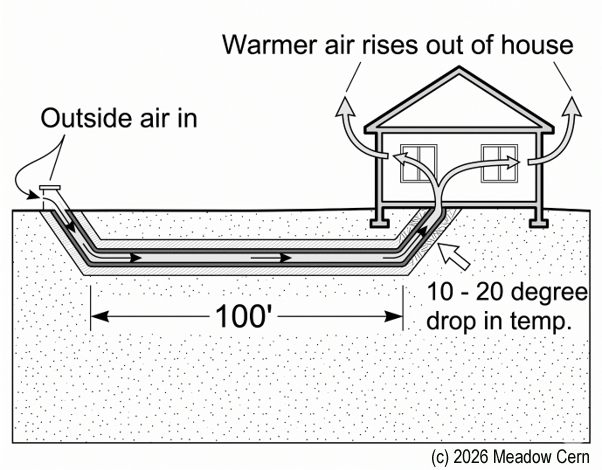
More people than ever are creating earth tubes in the ground for natural cooling that costs nothing once the tubes are purchased and installed. When I discuss this with people, one of the first questions that comes up is: What about mold?
This is the question I get more than any other, and honestly, it is the right one to ask. Somewhere along the way, earth tubes picked up a reputation as mold farms waiting to happen, and if you go digging through old forum threads, you will find plenty of horror stories to back that up. But almost every one of those stories traces back to the same handful of design mistakes, not to the idea of burying a pipe in the first place.
Why condensation happens
I’d like to take an example of why earth tubes work and what condensation has to do with it. Think about your average air conditioner… it pulls in hot air, cools it, and the by-product is condensation, which drips out of the unit. Earth tubes work the exact same way, except without electricity.
In the summer, you are pulling warm, humid outside air through a pipe that is sitting in cooler ground. When that air hits a pipe wall colder than its dew point, moisture condenses out. This is not a flaw. It is actually part of what makes earth tubes useful in the summer, because along with cooling the air, you are also pulling some humidity out of it before it ever reaches your living space.
The problem is not that condensation happens. The problem is what happens to that water once it forms.
Where old systems went wrong
Most of the earth tube horror stories you will find online come from systems built in the seventies and eighties, or from the DIY tube in a dad’s backyard for a science article. Common threads: flat runs with no slope, corrugated drainage pipe with ridges that trap standing water, and no way for that water to go anywhere except sit in the tube.
Give water a place to pool and a rough surface to cling to, and mold will move in eventually. This is physics. If you want to keep your tubes from molding, you need to have a way for that water to exit out and stay completely out of the tubes. If there’s corrugation, that causes little “ponds” of standing water in every single channel. This is a bad idea. If the trench does not have a deep enough bed of sand and/or gravel, the water pools. If you live in an extremely humid environment, such as Florida, there is risk of mold.
What actually prevents it
● Slope the tube, even a modest 1 to 2 percent grade toward a low point, so gravity does the work of moving condensate along instead of letting it sit. This is more important in humid climates than dry ones.
● Give the water somewhere to go. A gravel sump, a French drain, or a daylight drain at the low end all work. What does not work is when it sits in the tube too long.
● Use smooth wall pipe instead of corrugated. Ridges catch water and debris. A smooth bore lets both flow through instead of collecting.
● Keep enough airflow moving through the system. Stagnant air sitting in a tube for hours is a much bigger mold risk than air that is actually circulating. The air entering the home should be 5-20 degrees cooler than before it entered the earth tube, and it should be cool and dry.
● Build in an access point or two so you can actually inspect the tube years down the road instead of just hoping for the best.
Do all five of those and mold stops being a mystery and you can stop crossing your fingers in hopes that mold won’t arrive. Nip it in the bud before it becomes a design problem. Design it correctly from the start and you solved the issue before you ever backfill the trench.
How to make earth tubes
I go through the exact slope math, drainage options, soil types, and the specific pipe recommendations that hold up over years, not just one good season. Some earth tubes have been “running” (passively, there are no moving parts, and no electricity usage) for decades.
If you want the full breakdown, with diagrams, sizing information, and step by step installation, that is why I wrote Cool Your House Without AC: Free Air Conditioning for Life with Geothermal Cooling Earth Tubes. It is available now in paperback on Amazon and Barnes & Noble.
This is one of several articles I am writing about earth tubes and common issues or questions people have.
- PVC vs HDPE vs Concrete Pipe for Earth Tubes: What Should You Actually Use?
- Do Earth Tubes Cause Radon Problems? Separating Myth from Mechanism
- Will My Earth Tubes Get Moldy? The Condensation Question, Explained
- Free Air Conditioning Earth Tubes Are Real. Here’s Where to Actually Find the Instructions Free.
- Reflection Pool Before and After in Washington DC