
Question 3 of 6 answered
Once you decide you want t build a DIY earth tube (to cool your home without A/C), one of the next questions usually includes what pipe to actually buy. There are a couple real contenders, and some pipe to avoid at all costs, so here are my recommendations and why.
HDPE
This is one option that Larry Larson used to recommend in his well-documented modern builds from years ago.
The Pros
HDPE flexible 8” diameter single-wall corrugated HDPE (high-density polyethylene) drainage tubing, which is the standard black flexible pipe sold in coils at farm supply and landscape stores. It comes in long coils, which means far fewer joints for a given run length, and where you do need to join sections, fusion welding creates a seamless bond rather than a glued seam. It is flexible, which makes it easier to route around rocks or utility lines without a fitting for every bend.
The Cons
Unfortunately, although Larson’s many earth tubes were built for homes years ago and still work well, there is a problem of potential radon entering the home. Since the tube has lots of little slots where this invisible gas can enter up into the tube, and potentially into your home, it is best to avoid this kind of tube/pipe type if radon is a problem in your area.
Concrete
Concrete and clay tile earth tubes are the old school option, and you will still see them in large commercial or institutional installations.
The Pros
They can be built at a much larger diameter, which is useful at scale. However, the potential for problems is why the cons are more important than size.
The Cons
Unfortunately, the interior surface of concrete pipe is rough, which creates a lot more friction for air to pass through than a plastic or PVC option, and that rough surface is exactly the kind of texture that gives condensation and debris something to cling to. This also means mold growth can be a real problem. Since this is for air that enters the home, mold is something you want to avoid at all costs. For a DIY residential system, concrete is usually more trouble and expense than it is worth.
PVC
PVC is cheap, it is sold at every hardware store in the country, and most people already have some familiarity with cutting and joining it.
The Pros
Schedule 40 seems like the sturdier option, but not really worth the small upcharge over schedule 20 if you are going that route. Why? Because you want thinner walled PVC so that the thermal exchange can occur between the ground and the tube so that proper cooling can occur. This is good news because schedule 20 pipe is thinner, and less expensive. In fact, if you go with brand new sewer pipe, that has thinner walls than schedule 20 pipe so works more efficiently at cooling the air that enters your home. This means a cooler house than thick-walled pipe.
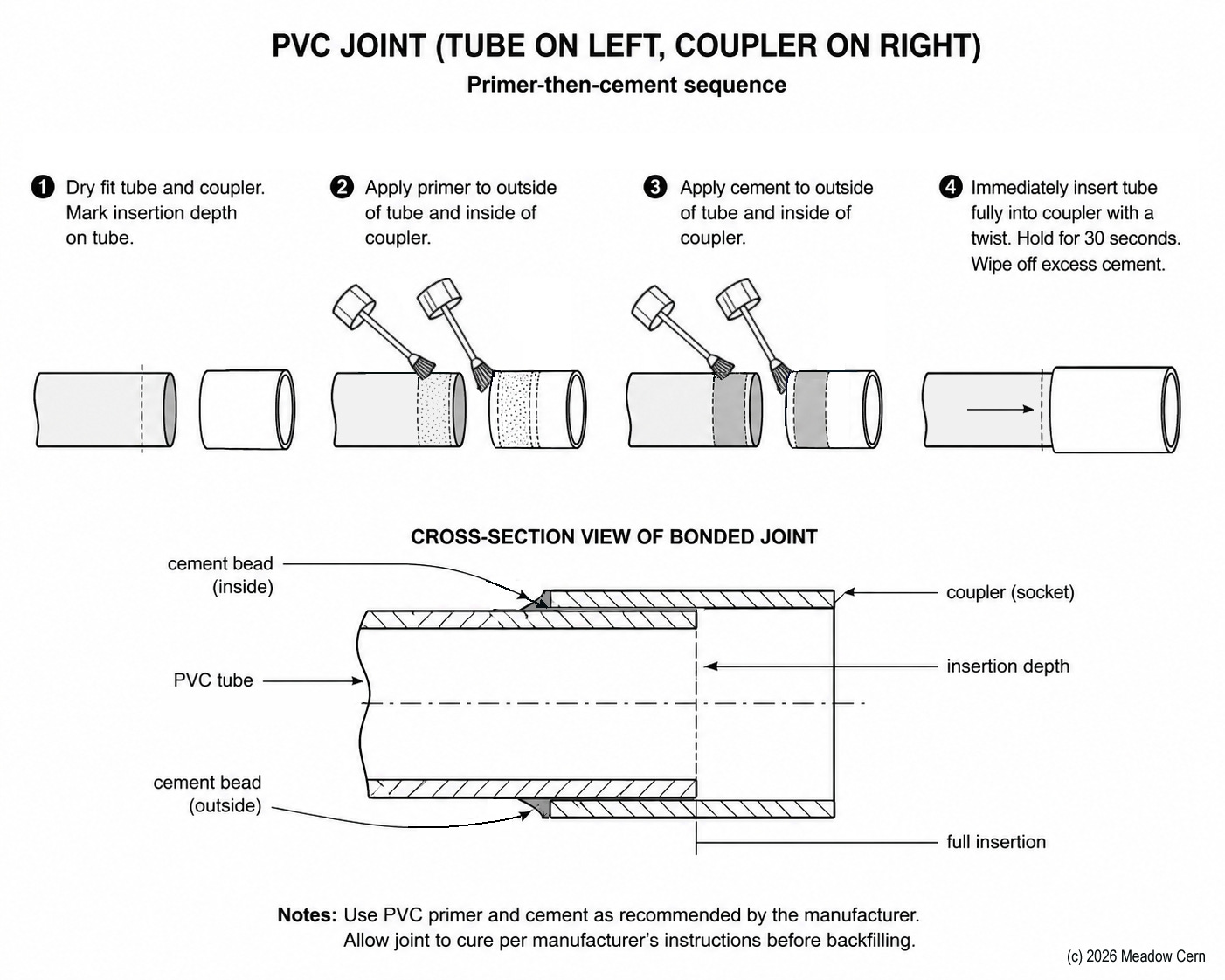
PVC pipe is also a plus because mold does not tend to grow on the inner surface, especially when compared to concrete, terra cotta tile, or other porous materials. PVC is completely waterproof and can be cut, glued and joined, and will hold a watertight seal to avoid radon penetration.
The Cons
The downside is joints. A long run means a lot of glued fittings, and every joint is a place where roots, moisture, or a future crack can start. PVC is also more rigid, so working around obstacles in the trench takes more fittings, which means more joints again.
My honest recommendation
For most homeowners building their own system, smooth wall 4-6” PVC sewer pipe is the sweet spot. If you use straight runs then you have fewer joints, smoother airflow, and it holds up to decades of underground thermal cycling. PVC is a reasonable budget option if you are careful about joint count and proper drainage.
I break down actual cost per foot for PVC pipe, plus the specific HDPE spec Larry Larson used. If you want the full breakdown, with diagrams, sizing information, and step by step installation, that is why I wrote Cool Your House Without AC: Free Air Conditioning for Life with Geothermal Cooling Earth Tubes. It is available now in paperback on Amazon and also through Barnes & Noble.
- PVC vs HDPE vs Concrete Pipe for Earth Tubes: What Should You Actually Use?
- Do Earth Tubes Cause Radon Problems? Separating Myth from Mechanism
- Will My Earth Tubes Get Moldy? The Condensation Question, Explained
- Free Air Conditioning Earth Tubes Are Real. Here’s Where to Actually Find the Instructions Free.
- Reflection Pool Before and After in Washington DC